Coal, Grit, and Memory: Tracing the Industrial Bones Beneath Nogata's Quiet Surface
When most Americans think of Japan, coal mining isn't exactly the first image that comes to mind. Bullet trains, sure. Sake breweries, absolutely. But a region defined by its underground labor history, by the men who descended into the earth every morning and came back up — when they came back up — covered in black dust? That's a different Japan entirely, and it lives right here in Nogata.
The Chikuho coalfield, which stretches across northern Fukuoka Prefecture and encompasses the Nogata area, was once the beating industrial heart of modern Japan. From the Meiji era through much of the twentieth century, this region powered the nation's transformation into an industrial giant. The mines are largely gone now, sealed or flooded or reclaimed by forest and farmland. But the history hasn't disappeared — it's embedded in the landscape, the museums, the faces of older residents who remember the roar of a working mine town.
For travelers who take the time to understand it, this industrial past doesn't just add context to Nogata. It fundamentally changes the way the entire region looks and feels.
The Geology That Started Everything
The story begins underground. The Chikuho basin sits atop one of the most significant coal deposits in East Asia, a geological quirk that put this otherwise rural corner of Kyushu at the center of Japan's industrial revolution. As the Meiji government pushed the country toward rapid modernization in the late 1800s, Chikuho coal became the essential fuel — for steel mills, for railroads, for the naval shipyards that were reshaping Japan's global position.
At its peak, the Chikuho region was producing more than half of Japan's total coal output. Towns like Nogata grew rapidly, drawing workers from across Japan and, eventually, laborers from Korea and China under circumstances that remain a significant and complicated part of the region's history. The population swelled. Infrastructure expanded. The landscape was reorganized entirely around the logic of extraction.
Walking through parts of Nogata today, you can still read the geology in the topography — the subtle depressions that mark subsidence from old tunnels below, the particular way certain hillsides were reshaped by decades of mining activity. It's a landscape that carries its history in its bones.
What the Mines Left Behind
When coal lost its economic dominance in postwar Japan — replaced by oil and increasingly automated industry — the Chikuho mines closed one by one through the 1960s and 1970s. The rapid depopulation that followed was severe. Communities that had been built entirely around mining infrastructure suddenly had no economic center, and many residents left for Fukuoka City or beyond.
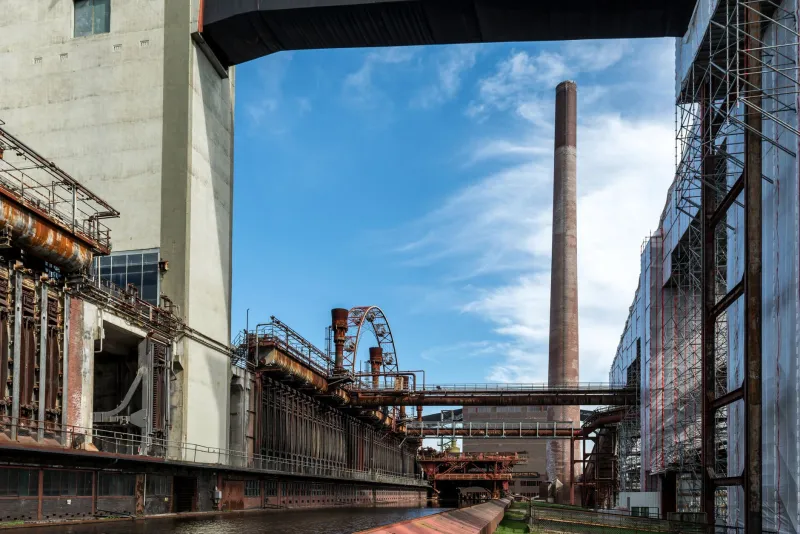
What remained was something unexpected: a landscape of industrial archaeology that has slowly, in some places, become genuinely beautiful. Abandoned pit-head structures rise out of vegetation that has spent decades reclaiming them. Old company housing rows, some still inhabited, tell the story of how mining communities were organized. Certain hillside paths that were once access routes to mine entrances now make for quiet, historically resonant hiking trails.
The Nogata area's former mining infrastructure is not preserved in the tidy, interpretive way of an American industrial heritage site. It's more honest than that — some of it is crumbling, some of it has been absorbed into the everyday landscape, and all of it requires some imagination and curiosity to read correctly. That's part of what makes it interesting.
The Museum That Doesn't Let You Look Away
For travelers who want the history laid out with full context, the local museums and community archives in the Chikuho region are extraordinary resources. The Tagawa Coal and Science Museum, accessible from Nogata, is one of the most substantive industrial heritage sites in Kyushu, with exhibits that cover the geology, the labor history, and the human cost of the region's coal economy with unusual frankness.
What sets these institutions apart from typical industrial museums is their willingness to engage with the full complexity of the mining era — including the forced labor of Korean and Chinese workers, the dangerous conditions that killed thousands, and the social stratification of mining communities. For American visitors, the experience offers an unexpected parallel to domestic conversations about industrial history, labor rights, and the communities left behind when industries collapse.
The photographs alone are worth the visit. Portraits of miners taken at the height of the industry's power are extraordinary documents of human labor — faces that carry the particular dignity of people who knew exactly how hard their work was and did it anyway.
Living Memory in the Streets
Beyond the formal museums, Nogata's mining history surfaces in the community itself. Older residents who grew up in mining families carry stories that no exhibit can fully capture. In certain neighborhoods, you'll still find the distinctive architecture of former company housing — compact, functional rows of homes built to house workers efficiently rather than comfortably, many of which have been modified and inhabited for generations since the mines closed.
Local festivals and community gatherings sometimes incorporate references to the mining era, honoring ancestors who worked the pits. The regional identity — the particular toughness and warmth that visitors often notice in Nogata's people — is not unconnected to a history defined by hard physical labor and tight-knit community survival.
This is the kind of cultural texture that doesn't show up in standard Japan guidebooks, which tend to focus on ancient history or contemporary pop culture while skipping the messy, complicated industrial middle. Nogata's mining heritage fills that gap with something real.
Planning Your Industrial Heritage Visit
If you want to build the mining history into your Nogata itinerary, a few practical suggestions:
Start with the landscape before the museums. Spend a morning walking the areas where old mining infrastructure is still visible in the terrain. Let the physical reality of the place sink in before you start reading the interpretive panels.
Allocate a full day for the Tagawa Coal and Science Museum if you have genuine interest in the history. The exhibits are extensive, and rushing through them does a disservice to material that deserves attention.
Talk to people. This sounds obvious, but in a region where the mining era is living memory for many older residents, conversations with locals can surface personal histories that no museum can replicate. A patient afternoon in a local coffee shop or community space can yield more understanding than a week of sightseeing.
Finally, sit with the complexity. The Chikuho mining history is not a simple story of industrial glory or uncomplicated tragedy. It's a layered human story about ambition, exploitation, community, and transformation. The travelers who get the most out of Nogata's industrial heritage are the ones willing to hold that complexity without rushing to a tidy conclusion.
The mountains remember. You just have to listen.