Two Wheels, Zero Crowds: Pedaling Through Nogata's Forgotten Back Roads
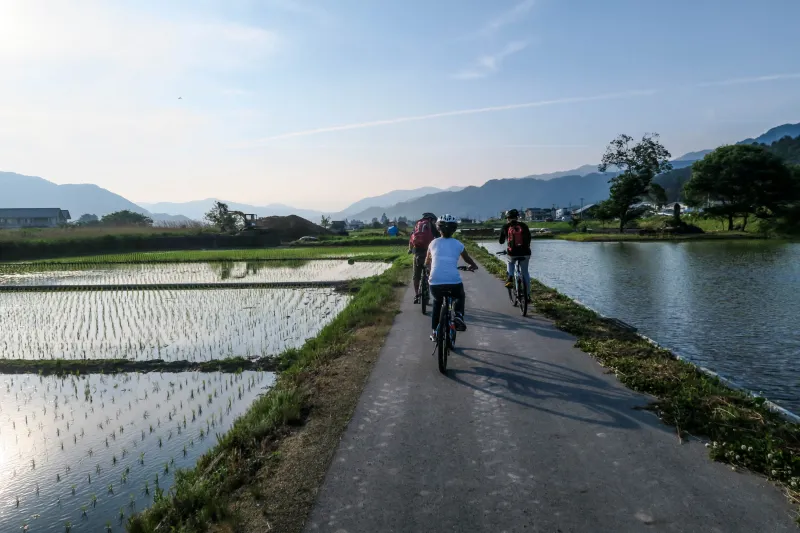
Photo: cycling rural Japan rice paddies countryside bicycle road, via www.amatteroftaste.me
There's a particular kind of quiet you only find when you're moving at bicycle speed through rural Japan. Not the silence of an empty room — more like the layered hush of wind cutting through rice stalks, a distant tractor engine, and the occasional surprised wave from an elderly farmer who clearly wasn't expecting to see a foreign face pedaling past his gate. That's the Nogata experience that no bullet train or tour bus will ever hand you.
Nogata sits in the northern part of Fukuoka Prefecture, and while most international visitors treat it as a pass-through point or a day-trip footnote, the cycling community here has quietly figured something out: this region's grid of narrow farm roads, riverside paths, and village lanes forms one of the most rewarding low-key cycling networks in all of Kyushu. You just have to know where to start.
Getting Your Wheels
Before you plan a single route, sort out your bike situation. Nogata Station has a small rental shop just a short walk from the main exit — nothing fancy, but the bikes are solid city cruisers and hybrid models that handle the mostly flat terrain without any drama. Rates typically run around ¥500–¥800 for a half day, which is roughly four to seven dollars. Cash is king here, so come prepared.
If you're planning a longer day or want something with a bit more range, ask your guesthouse or ryokan in advance. Several accommodations in the area keep a few bikes for guest use, sometimes at no extra charge. The owners are often your best source for route advice too — the kind of turn-by-turn local knowledge that no app will give you.
One practical heads-up: bring a small backpack. You will want to stop and buy things — a can of coffee from a vending machine, a bag of sembei crackers from a tiny neighborhood shop, maybe some seasonal produce from a roadside stand. Trust the process.
The Beginner Loop: Rice Paddies and River Roads
If you're not a hardcore cyclist or you just want a chill half-day ride, the flat loop that traces the edges of the agricultural fields east of central Nogata is genuinely hard to beat. The route covers roughly 10 to 12 miles and stays almost entirely on low-traffic roads where you're more likely to encounter a slow-moving kei truck than any real traffic.
The highlight here is the patchwork of rice paddies that stretch out in every direction, especially in late spring when the fields are flooded and the sky reflects off the water like a mirror. In late summer, the same fields turn a deep, saturated green. Come fall, they go golden. Honestly, any season works — the landscape just keeps changing its outfit.
Along this loop, you'll pass through a couple of small residential neighborhoods where the houses are old and the gardens are immaculate. Don't be surprised if someone calls out a friendly "Irasshaimase!" from a shop doorway or a grandmother pauses her sweeping to give you a long, curious look. International cyclists are still a genuine novelty on these roads. Lean into it — smile, bow a little, say "Konnichiwa." The interactions that follow are often the best stories you'll bring home.
The Intermediate Ride: Villages, Shrines, and a Surprising Shotengai
For travelers who want a bit more ground covered and a few more layers of discovery, the village circuit heading northwest out of Nogata adds some gentle rolling hills and a handful of stops worth lingering over.
This route — around 18 to 22 miles round trip depending on your detours — threads through several small communities that still have the bones of old Japan intact. Think low wooden storefronts, hand-painted signs, shrine gates half-hidden behind overgrown cedar trees. One of the villages along this stretch has a shotengai, a covered shopping arcade, that feels like it was preserved in amber sometime around 1978. A few shops are still open: a tofu maker, a hardware store, a tiny sweets shop where the owner will almost certainly insist you try a sample of whatever's fresh that day.
The shrines along this route are worth slowing down for. None of them are famous. None of them are on any "top ten" list. They're just small, maintained, genuinely used places of local significance — which somehow makes them feel more real than the heavily photographed landmarks further afield.
The All-Day Adventure: River Trail to the Edge of the Region
For the cyclist who came here to actually ride, the river trail route heading south and eventually looping back through the foothills gives you a full day of varied terrain and some of the most visually dramatic scenery in the region. Plan for 30-plus miles and pack accordingly — snacks, water, a light layer for the shaded stretches near the water.
The river sections are the payoff. The path hugs the water for long, uninterrupted stretches where the only sounds are the current and whatever birds have claimed the reeds that morning. Herons are common. Egrets too. If you're lucky with timing, you might catch local fishermen working the shallows, using techniques that haven't changed much in generations.
The return loop brings you through a series of hillside neighborhoods with elevated views back over the valley and the city beyond. It's the kind of perspective that reframes everything — suddenly Nogata's scale makes sense, and you understand why people here feel connected to their landscape in a way that's harder to find in larger cities.
The Unplanned Detours Are the Whole Point
Here's the thing about cycling Nogata that no route description can fully prepare you for: the best moments won't be on any map. They'll be the side road you turned down on a whim that led to a family-run vegetable stand where you ended up spending twenty minutes attempting a conversation in broken Japanese and enthusiastic hand gestures. They'll be the temple courtyard you rolled into by accident that turned out to be completely empty and completely perfect. They'll be the vending machine coffee you drank while sitting on a concrete wall watching a field that had nothing happening in it whatsoever.
American travel culture tends to optimize everything — the best route, the most efficient itinerary, the highest-rated stops. Cycling Nogata works best when you resist all of that. The slower you go, the more you find. And at bicycle speed, you're moving just fast enough to cover ground and just slow enough to actually see it.
Rent the bike. Pick a general direction. See what happens.