Word Got Out: How American Travelers Are Quietly Abandoning Their Japan Guidebooks for Nogata

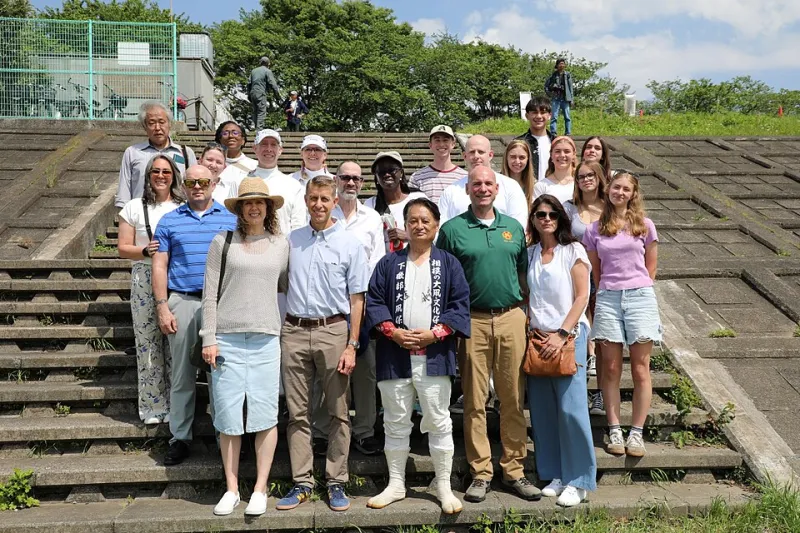
Photo: U.S. Army USAGJ by Noriko Kudo, Public domain, via Wikimedia Commons
Something unexpected is happening among American travelers heading to Japan. A growing number are skipping the usual checklist of Kyoto temples and Tokyo neighborhoods in favor of a small city in Fukuoka Prefecture that most guidebooks don't even mention. Nogata isn't trending in the flashy sense, but it's spreading the way the best secrets always do: quietly, person to person, with a kind of possessive enthusiasm that's hard to fake.
Call it the Nogata Effect.
The Discovery That Starts With a Comment Section
For a lot of American visitors, the road to Nogata begins somewhere strange — a Reddit thread, a buried Instagram caption, a TikTok comment under a video about Fukuoka ramen. Nobody's running a big ad campaign. There's no sponsored content push from a major tourism board. It's just people who've been there telling other people who are planning to go.
Jessica, a teacher from Portland who visited last spring, put it simply: "I was deep in a Japan travel subreddit at like midnight, and someone mentioned Nogata almost in passing — like, 'if you really want to see how people actually live in Fukuoka, get on a train and go here.' I wrote it down and forgot about it. Then three other people said the same thing in different threads over the next few weeks. At that point I figured the universe was trying to tell me something."
That pattern — multiple low-key mentions across unconnected platforms — is something you hear over and over from Americans who ended up in Nogata. It wasn't a single viral moment. It was accumulation. Slow burn discovery in an era that's supposed to be defined by instant everything.
The Psychology of the "Undiscovered" Place
There's real psychology behind why a destination like Nogata pulls at certain travelers the way it does. Travel researchers have written about what's sometimes called "anti-tourist" behavior — the desire not just to visit a place, but to visit it before it becomes the kind of place that everyone visits. There's status in that. There's also something more genuine underneath it.
Marcus, a freelance photographer from Chicago who spent ten days in Nogata last fall, described it this way: "I've done Tokyo twice. I love it. But I started to feel like I was just executing a script — here's the shrine, here's the ramen shop with the line around the block, here's the photo spot. Nogata felt like I was writing my own script. Nothing was pre-packaged for me."
That sense of authorship matters to a particular kind of American traveler — one who's done the highlights, absorbed the Instagram version of Japan, and is now hungry for something that resists easy captioning. Nogata, with its working neighborhoods, its family-run izakayas, its streets that don't have English signage on every corner, offers exactly that kind of friction. And increasingly, that friction is the point.
What People Actually Find When They Get There
The interesting thing about the Nogata conversation online is how consistent the surprise is. People arrive expecting a quieter version of somewhere else and find something that operates entirely on its own terms.
Sarah, a marketing professional from Austin, had been to Japan four times before her trip to Nogata. "I kept waiting to feel like I was in a lesser version of somewhere bigger," she said. "That feeling never came. The food scene alone — I ate things I couldn't identify and loved every single one of them. The locals weren't performing for tourists because there basically weren't any other tourists. It was just... real life. I found that incredibly moving, honestly."
That word — real — comes up constantly in these conversations. It's doing a lot of work. What travelers seem to mean by it is a combination of things: the absence of a tourist performance, the presence of actual community, the feeling that the place you're walking through is not maintained for your benefit but is simply alive in its own right.
Nogata's agricultural roots, its craft traditions, its neighborhood onsen and local ramen joints — none of it was built with international visitors in mind. And paradoxically, that's exactly what makes it so compelling to international visitors right now.
The Guidebook Problem
Here's the uncomfortable truth that experienced Japan travelers are starting to talk about openly: the major guidebooks have created a kind of feedback loop. The places they feature get more visitors, which changes those places, which makes them less like what the guidebook described, which prompts travelers to go looking for the version of Japan that the guidebook promised but can no longer deliver.
Nogata sits outside that loop almost entirely. It's not that it's been overlooked because it's unworthy — it's that the infrastructure of mainstream travel writing has simply never turned its attention there. Which means it remains, for now, genuinely itself.
Derek, a history teacher from North Carolina who spent a week in Nogata researching Chikuho coal history, said he bought three different Japan travel books before his trip and found maybe two sentences about the region across all of them. "I ended up learning more from a twenty-minute conversation with a guesthouse owner than from everything I'd read," he said. "That's not a knock on the books. It's just that Nogata exists in a different knowledge ecosystem. You have to seek it out through people."
Why This Moment Feels Different
Japan has always had under-the-radar destinations. What feels new is the speed and reach of the word-of-mouth network that's now surfacing places like Nogata to American audiences. Social media has compressed what used to take years — the slow spread of a destination's reputation through travel writing and personal recommendation — into something that can happen across a single travel-planning season.
But there's a nuance worth holding onto. The Americans finding Nogata aren't the early-adopter thrill-seekers who chase obscurity for its own sake. They're increasingly mainstream travelers — people who've done Tokyo and Kyoto, who loved Japan, and who are now asking a more sophisticated question: where do I go to find the version of this country that isn't already built around people like me showing up?
Nogata's answer to that question, it turns out, is just to be exactly what it is. No reinvention required.
The Part Nobody Talks About
There's a quiet responsibility that comes with this kind of discovery, and the most thoughtful travelers who've been to Nogata are aware of it. The thing that makes the place special is precisely its distance from mass tourism. That's not infinitely durable if the word spreads too fast or too wide.
For now, though, the scale is still human. The travelers arriving are curious, respectful, and genuinely interested in the place rather than the photo. And Nogata, for its part, receives them the way it receives everything — without fanfare, without performance, with the quiet confidence of a place that's never needed outside validation to know its own worth.
That might be the most Japanese thing about it.